Monday, October 17, 2005

Weird misc

Just some links while I prepare something decent to post here.

"Camera geeks take aim" - About the kind of otaku addicted to cameras. Some pay for picture sessions with models...

"No point in going if you can't wait in line" - The strange relationship between lines and people's interest in attractions.

Friday, October 14, 2005

Handwriting

I think everybody has had some friend or teacher whose handwriting is hard to understand. Although the alphabet used is the very same, as time goes on people's handwriting usually turns out to something different than textbook calligraphy. Some are beautiful, some ugly, some hard to understand and so on... And having contact with other handwriting styles helps us to recognize things written in a style different of our own.

Well, that's not only for alphabet (here called "romaji"). Japanese characters naturally have this kind of peculiarity. The shodo masters have what could be called good calligraphy, and Japanese schools usually teach standard handwriting.

Now to the Dark Side...

During classes, I've noticied that many characters written are a little (or sometimes a lot) off compared to the the "standard way". Add the fact that my kanji comprehension not good and I end up often copying what teachers write on the blackboard just like copying a drawing, having no idea of the meaning of the word of even which character is that. Sometimes I figure out later what's the character, but usually not.

Well, I'm not criticizing... that's natural, but it's kinda complicated when it's not the characters you're used to. And as I've never seen real Japanese common handwriting before, I still don't have the sensibility to distinguish some characters while Japanese (and some foreigners that have stayed for long) can do it easily. However, in some cases handwriting is so strange that even Japanese have trouble trying to find out what's written (deja vu...).

That's a thing usually overlooked on Japanese classes, but that people coming to Japan will face someday... hehe... Anyway, classes about handwriting pratically don't exist... the only way to get used to it is having contact with it and learning little by little, right?

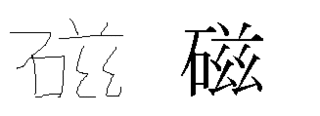
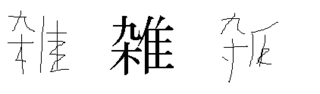
Now some examples to show what I'm talking about. Surely, since I tried to copy them like drawings at first, my examples are even worse than the original writings... Also, those are not standard handwriting, just some interesting examples I have.

First, the writing for the kanji "ji" (magnetic) used in words such as "jiki" (磁気 - magnetism) or "jiba" (磁場 - magnetic field).


Second, the kanji "zatsu" (miscellaneous), used in words like "zakkan" (雑感 - miscellaneous thoughts) or "netsuzatsuon" (熱雑音 - thermal noise).


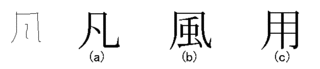
Some questions to finish. The kanji drawn on the left is equivalent to (a), (b) or (c)?


The answer is (a)... "aida" (during, between)

Second and final question: The kanji drawn on the left is equivalent to (a), (b) or (c)?


The answer is (b)... "kaze" (wind).

Well, imagine those things appearing during classes, for example... You have to copy, pay attention (at least to catch the reading of the character) and understand the thing later...

For those who have read the previous post... I guess it may be just impression, but I think there're more police cars around this area lately... XD

Wednesday, October 12, 2005

The boys in blue

I was planning on returning the "Reminiscences" today, posting, finally I should add, pictures from Kyoto. But a strange (but funny somewhat) thing hapenned today and I'd rather talk about that.

Ok. I have one class in the morning and one in the afternoon on Wednesdays. It just happened that I noticed a little after lunch I'd forgot some notes for afternoon class. As I live near the university and I came by bike (so it wouldn't take 20 minutes to go and return), I was cycling back home to retrieve it.

In the midway, there was a police car and two officers. I don't know what they were doing, but as one saw me he asked me to stop. No idea why he asked, but, anyway, I still had some time, so I stopped.

In the dialogue that followed, he asked if that was really my bike (through the Japanese Indirectiveness Translator it'd be something like asking 'did you steal that bike?'... ^ ^; Really... only in Japan this kind of things happen... I wonder if a real thief would answer that he'd stole it...). It's my bike, although it was only lent to me. No sweat answering this kind of question, but I wondered why would he ask that out of the blue.

"There've been some bicycles being stolen in the area" was the response. I know that well, some friends had their bikes stolen already. And that's one of the few things that are stolen more frequently in Japan. But I started to think that he thought I was one of those thieves for what happened later...

First, his behavior changed a little after (finally) realizing that I wasn't Japanese. Second, he seemed upset when I said I couldn't remember the name of the person I borrowed the bike from, although I made it clear that it was borrowed (not stolen) and some people would confirm that. Third, the "reason" why he stopped me was because he "didn't see any lock on my bike". Hum... I use one I bought at a 100 yen shop (something like the $1 shops or the "lojas de R$1,99", but the variety of items is astonishing) which stays in the basket when I'm cycling (so he really couldn't see any), but I saw other bikes using the same kind and some like that passed through during the conversation (there were two officers, remember? And one was talking to me)... This excuse sounds a little lame... Fourth, the officer strangely became silent when somebody was walking around, only resuming the conversation after that person was a little far away (out of listening range)... And fifth, the other office approached and started to write some sort of number that was written on my bike. Then I started to get angry... I believe that here, too, mothers usually teach kids to ask for permission, right? Where's the famous Japanese politeness, anyway?

But, anyway, I'd read already that it'd better not start a discussion with a police officer, but play humble instead... So I did that and it worked a little. At least the reaction went to something I'd classify as "neutral". And some time later, when the conversation reached a point where "there's nothing left to talk" he dismissed me, however only after emphasizing I should return the bike to the owner... WHAT!? Now it's illegal to borrow things!? Ah, I was late already, so I just said the Japanese "hai" (yes) and left. Interesting thing is that many Japanese use this word as "yes, I understand", not as "yes, I agree/will do" like most westerns, hehe... Hey, don't get me wrong! I will return the bike. But he didn't say when, so I'll return it just before returning to Brazil XD...

And one final note. All that happened when I was going home. When I was returning to the university (less than 10 minutes later) they weren't there anymore... Interesting... I'm starting to agree with this article...

Kids on TV: exercises and public security

Para aqueles que preferem posts em portugues, foi mal. Mas to com uns visitantes internacionais agora (quem le ate acha que to podendo...) e vou ter que aumentar um pouco o numero de posts em ingles. Mesmo assim nao vou deixar de escrever na minha lingua materna (... pq esse vocabulario agora?). Os relatos das ferias de verao serao mantidos em portugues. So quero ver quando acho tempo pra mexer nas fotos... Daqui a pouco chega o inverno e ainda nao terminei os albuns de verao...

Ok, back to English. During some idle time on Monday I decided to watch TV (a decision that I sometimes end up regretting... Here too seems like most of the good stuff is only on cable/satellite channels). There was a report about the Sports Day (yeah... and it's even an official holiday). In this day some schools test their students' physical ability (elementary and junior high schools mainly, I guess) and the results showed that, although certain features like avarage height have raised/improved, seems like physical abilities are decreasing. To arrive at that conclusion they compared data such as "Average time taken to run 100m" or "Average distance they can throw a ball" with the results of those measures years ago (with other students, of course).

Uh... I don't know... but I think such tests weren't necessary to get that conclusion. Kids don't play outside so often. Some barely have time to play because of activities such as cram schools. Even at university not all students are members of some sport club or even exercise frequently. And that's not only for Japan. That applies to many other countries (Brazil included). Here there's also another thing. This is the land of Game Boys, PlayStations and other eletronic enterteinment... I was not that surprised when I saw on the news other day something about the revival of "analog toys". The point was to improve communication and exercising.

Another thing I saw on TV was a show in which two kids (brothers and/or sisters) go shopping alone for the first time to buy somethings mom asked (simple things. The point is the "adventure"). Note: I know that some Japanese look lots younger than they really are, but none of the kids seemed to have more than 5 years old.

That's to think about public security. I don't think this kind of thing would be possible in Brazil... I've been writing about strange things in Japan. Time to praise a little. Although the fact that Japan is a relatively secure country is well known, we usually aren't aware of that, only realizing the difference after returning. Yep. It's easy to get used to good things to the point you don't even notice them anymore...

And Japanese kids are cute... Like when returning home, a boy whom I guess was no more than 3 years old (and tripped falling on the floor at least 5 times) just sat in the street saying "tsukareta" (I'm tired) and not willing to move. Much to the despair of her sister (around 5yo I guess). And later the crying of both when returning home and seeing mom and dad again... Hum... maybe I should review my opinion. Seems a little tough to the kids... But the boy saying "tsukareta" was funny...

Strange thing: I wonder if nobody really tried to help the kids or if they cut parts on which somebody offers to help. Can't imagine that nobody would try to help two children sitting on the walkway and crying...

Tuesday, October 11, 2005

Kansai and Hanshin Tigers

Some basics first. Kansai or Kinki is a region in the southern half of the Honshu island (Japan's biggest island). For those more in the known of Japanese Geography, it's defined as the cities (fu) of Osaka and Kyoto and the prefectures (ken) of Hyogo, Mie, Nara, Shiga and Wakayama. For some it's only the Kei-Han-Shin (Kyoto-Osaka-Kobe) region, but I won't discuss that.

Well, I believe that's one of the best places in Japan to live. And many people I know agree with that. As far as I know, natural disasters don't strike here so often and transportation between cities is relatively good (for example, the frequency of shinkaisoku - "super rapid" - trains if compared with the Tokai region). But probably the best thing is that people are more friendly. I haven't been to other regions for long, but that's my impression so far. People tell more jokes naturaly, are more expressive, and even the local dialect, the Kansai-ben (that I'm trying to learn), is more expressive and funnier than standard Japanese (a.k.a. Tokyo dialect).

Another interesting thing about Kansai is the relationship with a local baseball team: the Hanshin Tigers. From the book "Colloquial Kansai Japanese" (PALTER, DC; SLOTSVE. Tuttle Publishing, 1995): "Living in Kansai is synonymous with rooting for the Hanshin Tigers. Even people who hate baseball will say they hope Hanshin wins. (...) This is not to say that Hanshin is a good team (...). Most years find them languishing in the cellar of the Central League, which only seems to increase their lovability as the underdog." A little exaggerate, maybe. But not by much... "The Tigers home stadium is Koushien in Nishinomiya, between Osaka and Kobe and near the base of Mt. Rokko." And it just happens that Nishinomiya is a sister city of my hometown in Brazil: Londrina. (Which reminds me that I should go there someday...)

And one might ask why I'm telling all that. Well, it's a different information about Japan, isn't it? But there's another reason. Hanshin won the Central League this year and, as a result, many stores in the area are doing bargain sales. Some friends are taking the oportunity to buy things, like last Sunday when one was showing some "fall clothes" or Monday, when I went shopping with another friend (actually I ended up just watching... Don't even know why...). Think I should try buying at least some winter clothing, although money is short after summer vacation (ah... that was the reason...). Sales will go until next Monday, I guess.

Just another curiosity about Hanshin Tigers. When the team won the Japan Series for the first time a strange episode occured. A statue of Colonel Sanders of Kentucky Fried Chicken (some franchising "McDonald's-like") was thrown into the Doutonbori River (in Osaka). There're many versions of this story. The following is extracted from the "Colloquial Kansai Japanese"

"When Hanshin won the Japan Series for the first time in 1985, the fans went crazy. One group gathered at the Nampa Bashi over the Dotonbori River, and as people called out the names of their favorite players, someone would jump into the river. However, when they called out the American player, Randy Bass, who helped lead the team's success, there were no foreigners in the crowd to represent him. The closest thing to a foreigner they could find was the Colonel Sanders statue in front of the nearby KFC restaurant, which they threw into the water."

"The restaurant never replaced the statue, and soon afterwards Hanshin went into a deep slump. Some people claimed this was due to a jinx wrought by the Colonel himself. When, in 1992, it looked like Hanshin would win the Central League pennant, the shop finally replaced the statue. However, knowing the character of Hanshin fans, the management chained the statue to the front of the restaurant. Unfortunatelly, the team blew the last few critical games and failed to win the pennant. Maybe they shouldn't have kept the Colonel chained down."

And, this year, when it seemed like Hanshin would win the Central League (something that did happen this time), some sort of "barrier" was put at the Nampa Bashi to prevent people from jumping into the river. Even so, I heard that some did jump, although less than previously...