Sunday, May 03, 2009

Business Cost

Talking to people from different backgrounds brings some interesting insights. In times of economic meltdown and all the crisis people around the globe are even getting tired to hear about (and feel too), companies are looking for ways to cut costs.

One of the most usual ways is firing people. We have been seeing that around the globe. And Japan is no exception. So much that Japan is offering some money to some foreign workers to go back home... and don't come back. Anyway, that's a different subject. The point is that some people don't think that firing people is the best solution (and to defend Japanese companies, neither do they. Work-sharing approachs are on the rise).

I agree with that point of view, but what to do then? Although the problem has no simple solution, I've been in contact with some Japanese companies lately (because of job hunting and other activities) and I get impressed with some costs that, as individuals, we'd find outrageous.

Costs with transportation and telephones are one example. Companies often pay for transportation of its employees (when it is something work-related) - which even was the source of some scandals - and business calls. One example that surprised me a little was when a employee was calling a Brazilian company to discuss sales... from a mobile phone. I can hardly imagine how much a one-hour call bill would be.

I am not saying that companies should cut these benefits altogether, but regarding the "communication" part, Chinese friends say that many companies in China are using instant messaging tools as Skype or MSN or another program that is popular in China (I forgot the name) for business. Even if it is only for customer support.

Example: you need to look for a hotel. You check the hotel's web page and want to ask something, or even ask for the reservation already. The page has a link to their Skype/MSN/etc. account, so you can access, talk directly to an employee and solve your doubts.

I have to admit there are some risks as well, but the system is interesting. Even more considering that so many companies in other countries actually forbid their employees to use such software at work.

Wednesday, April 29, 2009

伊勢 (Ise)

Ok, ok. I've been away for very long this time. Anyway, going back to business...

Going a little back in time, from November 29th to 30th I went with the iAT group to Ise.


The main attraction was also the first one: Ise Jingu, Japan's most sacred Shinto shrine enshrining Amaterasu, the Sun Goddess. This shrine is also mentioned in many quotes and books, including Eiji Yoshikawa's "Musashi". No, no pictures are allowed close to that area, although it is allowed in most parts of the shrine. And given the amount of people there I wouldn't dare to take a snapshot.

Another thing Ise Jingu is famous for is that it is rebuilt every 20 years as a part of the Shinto belief of the death and renewal of nature; so the structures will be forever new and at the same time forever ancient. According to Wikipedia, the next reconstruction is due in 2013.

Although all that importance, the shrine itself has an interesting simplicity. Interesting reminder that something doesn't need to be fancy to be important.


Also, during the trip we stayed in a ryokan (sort of hotel) close to Meoto Iwa, or Husband-and-Wife Rocks. It is basically two rocks connected by a rope that weights over a ton and has a important meaning in Shinto belief as well. An interesting sight, especially since my parents had a framed picture of the place and I always wondered about where it was.

Too bad I wasn't there on the best times to see it. It wasn't summer, so I missed the sunrise between the rocks; and the tide wasn't low to see the rocks connected. I could take some nice night pics, but after seeing on the net one with the moon on the back, mine aren't so nice anymore...

On the next day, still sround the same region we went to Toba. Although the main attraction of the city is probably the Aquarium, as the weather was very nice most people decided to take a boat cruise. And it was fun, especially when we were throwing food to seagulls nearby and got many of them trying to follow the boat eventually.

The last stop was an observatory from where we could see the Toba and other areas of the Shima Peninsula. And after that, we went back to Kyoto... very tired and with one more famous spot in Japan visited.

For those who want to see more pics, check my Picasa album.

Monday, March 09, 2009

If snow doesn't come to Kyoto - Nozawa Onsen (野沢温泉)


After going to Sapporo Yuki Matsuri, I was still missing something that can be done when it snows: snowboarding!

I tried to organize a ski/snowboard trip, but all my attempts failed. When hope was diminishing, Meg sends me a message inviting me to go to a ski site. Talk about mind reading! And the weekend chosen was the best choice for me as well.

I was also allowed to bring some friends, so I invited some friends who already had mentioned they would like to go ski/snowboard somewhere. I just forgot about the chain effect that usually happens in those cases: like when I went to Takaifuji last year, a friend called another, who called another... Although I knew all people who were invited, some people decided to join almost on the closing date for reservations.


Regardless of those minor problems, we managed to go to Nozawa Onsen Snow Resort in Nagano on February 21st to 22nd with a group of ten people from nine different nationalities. Again like Takaifuji, it was an "international summit" ski trip as Steffa pointed.

I am getting better with a snowboard. The only thing I have to remember is to tell the rental shop that I am a goofy next time. I always forget because when playing soccer I kick the ball with my right foot (even though I'm left-handed).


The landscape seen from the ski station is beautiful. If I weren't with a snowboard I'd probably like to go around and take some pictures. Those I took aren't all that nice.

The snow was also great. Powder snow accumulated until noon, when it stopped snowing and we had a clear sky until we returned to the hotel. And returning was also a small adventure, since I decided to try intermediate tracks with Meg, Steffa and Stefan. We forgot to calculate the time to get down the mountain to return our rental equipment on time and we had to rush to the base of the mountain after losing one of the lifts on our way down.

More fun with weird games after dinner (in the boys' room that was conveniently placed in the meeting room with no other guests in the rooms on the sides... Coincidence?) and walking around the town the next day completed the trip.

Since the name of the place is "Nozawa onsen" it has hot springs. We decided to go to one that's famous and free to use. Overall the atmosphere is nice with the place itself being small having a rustic design, but the water was too hot! It was like feeling what a boiling egg feels like... I could stand for a while only. It was nice nevertheless.

Snowboarding in 2009... check. With hot springs as a bonus. I think I can say I enjoyed winter now... now may spring come bringing ume and sakura!

Saturday, February 28, 2009

If snow doesn't come to Kyoto - Sapporo (札幌)

This has been an unusual winter in some ways. One of them is that it almost didn't snow in Kyoto... at least not enough to cover the ground for me to go around taking pictures.

In that case, what would become of my winter pictures in 2009?

Fear not. There was already something in my sleeve. An old wish to tell the truth.

Since I went to Himeji in 2005 I wanted to go see the Sapporo Yuki Matsuri. Still, when in Himeji I didn't have the money to do it, and last year I had my entrance exam. This year I had some JAL mileage about to expire - thus another reason to avoid postponing this trip any longer.

Another helping factor was hearing from a friend that some Brazilian exchange students were planning to gather a group to go see the festival. Thanks to that, I also got a group to have fun with and some local intel - including hotel reservation - from students living in Sapporo (Thanks Erica, Arlete and those who helped organizing the whole thing!).

Therefore, from February 6th to 9th I went to Sapporo to see the Sapporo Yuki Matsuri with a group from many different prefectures in Japan (from Yokohama to Miyazaki) of Brazilians and friends.


Those were intense four days. Even though I didn't go anywhere out of Sapporo, all four days were well spent. Especially because it's not a place simple to revisit if you are a poor student.

The "locals" said that it almost didn't snow prior to our arrival. And then we came bringing a small snowstorm with us. Nevertheless, there were periods of good weather that fortunately happened mostly while we were sightseeing.

Our group splitted in many occasions; and that was fortunate since people had different interests and it's simpler to coordinate a smaller group. The places where I've been were:


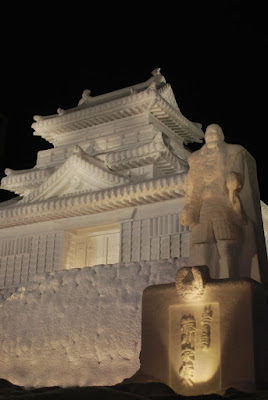
  • Odori koen: The most famous area of the Yuki Matsuri. The place where the large sculptures are, although there were small ones as well. There are many companies and groups interested in obtaining a space to create a snow sculpture there. My friends in Sapporo managed to participate (together with a group) in creating one under a company's name. Some sculptures worth of note were one promoting Tokyo's bid to host the 2016 Olympics and a Disney themed sculpture built by the Japanese Self-Defense Force. There were also Totoros, Ponyos and other icons. Odori was the first place I went; and I went all four days there.


  • Susukino: Not far from Odori, Susukino is a night district - or a "red-light district" if you prefer. During Yuki Matsuri, the area has many ice sculptures (while the ones in Odori are usually on snow).


  • Tsudome: Nickname for the Sapporo Community Dome, the area was designed to hold one of the three sites (the other two are Odori koen and Susukino) for the Yuki Matsuri that was previously alocated in Sapporo Satoland from 2006 to 2008 and in Makomanai SDF base before 2006. Although there are some sculptures, the Tsudome area has an emphasis in providing playing space for children (in heart also).


  • Mt. Okura Ski Jump Stadium: No, no one is good or crazy enough to try a ski jump. Instead, there was an event on the day where, among other activities, we could slide down the ramp on a tire tube. I didn't do it, but it's also possible to go to the top and have a view of Sapporo.


  • Moiwayama: That's an excellent place to go up the ropeway and see the city of Sapporo from above. Although the view is beautiful day or night, watching the sunset and the first hours of the night is a personal recommendation.


  • Kaitaku no Mura: Translated as "Historical Village of Hokkaido", the complex concentrates typical buildings from all over Hokkaido from the period when development of the region was carried on a large scale. Since that started during the Meiji period, most constructions have a certain European atmosphere, different than the usual traditional Japanese structures. We could also try jyagamochi ("potato mochi") and something that I guess was amazake.


  • Sapporo Beer Museum: Hokkaido is the birthplace of beer in Japan, and Sapporo Beer one of the oldest and most popular brands. The museum itself tells the history of beer and the process of making it. Unfortunately, we didn't arrive in time to enter the museum. Our real objective lies in a different part of the complex: Sapporo Beer Gerten with an all-you-can-eat sheep meat Genghis Khan (Mongolian BBQ).


  • Shiroi Koibito Park: Shiroi Koibito is a famous brand of chocolate based in Hokkaido; and the park tells the history of chocolate, has a museum with nostalgic toys from various countries, allows visitors to try making cookies themselves, and has a buffet of cakes. Arriving at the place, some people may have a feeling of approaching Willy Wonka's chocolate factory.

Those who wish to see more pictures, check my Picasa album.

Friday, February 27, 2009

Drug use prevention campaign

Enforcement of the anti-stimulant drugs law in Japan can be very severe. Quoting UK's Foreign Commonwealth Office site:

Detention for minor offences can be longer than in the UK, and prison regimes in Japan are very strict. Japan has a zero tolerance policy towards drug crime and there are severe penalties for drug offences, however minor. Detection facilities at airports and post offices are effective. There have been a number of cases of small quantities of cannabis being sent through the mail to Britons living in Japan, which have resulted in the arrest and detention of the recipients. Japanese Police have been known to require customers of bars to give samples for drug trace testing. Tests proving positive lead to arrest and prosecution, even if the drug was taken before arrival in Japan.

The use or possession of Vicks inhalers and some other common prescription and over-the-counter medicines (e.g. for allergies and sinus problems) are banned under Japan’s strictly enforced anti-stimulant drugs law. Customs officials may not be sympathetic if you claim ignorance about these medicines. If in doubt, check with the nearest Japanese Embassy before visiting Japan.


And although there are cases where it was found that Narita airport customs' officers planted small quantities of drugs on passengers' luggage to train sniffer dogs, the usual official stance when it comes to drugs is "ダメ、ぜったい" (Absolutely no).

Recently, there were many cases on the media of people busted for illegal drug possession. Of course, to reach the media in this intensity, those were not just "normal people"... at least not for Japanese standards.

Cases related to sumo wrestlers, especially those who already have a certain reputation, are bound to reach the news. Sumo was almost a sacred sport in past generations, and it is still very important nowadays, with any scandal related to the sumo world reaching the headlines.

Considering how Japanese society values the groups one belongs to, when students from prestigious universities are arrested by drug possesion it also becomes news. And recently whose news are on the rise, with students from universities like Keio, Waseda and Tokyo busted.

Actually, since the Tokyo case involved an international student, there was some aprehension that foreigners in general would get the blame (as it sometimes happens for foreigners are also seen as a group in some cases). Fortunately, it didn't happen as far as I could sense. Not that placing the responsibility mainly on the university is any better in my opinion.

And there was also a case on the university I study, Kyoto University. After I read that, I was wondering how long it would take for students to receive a notification with some sort of drug use prevention message.

I received such message, but some points of it made me think...

The weirdest of all is when they evoked "human rights":
「日常の様々な行動の中で、人権の尊重や法令遵守の重要性を自覚し、良識ある行動をとりましょう。」
Roughly translated as:
"In our everyday acts, let's be conscious of the importance of respect for human rights and observance to laws, taking sensible actions."

I'm awful in translation, so probably the meaning became weirder than the original message. Still, I checked The Universal Declaration of Human Rights and couldn't find an obvious link to the drug problem. I wonder if it's because I'm not good in Law or if the word "human rights" is becoming banalized in Japan as "sexual harassment" is becoming in a certain way...

However, they did address one important point in this question. Some of my previous links also point that many people try drugs incited by friends or seniors. The message also mentions to be careful about those situations and to have the courage to say "no".

I have to admit it's a good initiative about the drug problem. Still, it would be a good idea to investigate the full reasons why students try illegal drugs. That's a hard thing to survey.

Well, it's not a simple question and I don't have a full picture on how things work in Japan (not even in Brazil to tell the truth).

What makes me wonder more - and I am not saying the drug problem is not serious - is that I really don't think there was a sudden boom in consumption (although I do believe in a steady increase). Instead, the media attention has turned to this topic. That might also put more pressure on the authorities that do more throughout checks, resulting in even more people busted. Anyway, it's hard to believe that all those cases being broadcasted coincidently just happened in the last months.

So what was the factor that turned the media's attention to that problem?

-----
Added on March 2nd:

I had to rectify myself in some point. Although I don't think there was a sudden boom in consumption of drugs, I do believe that it has been increasing over the years. A US report seems to agree with me. That leads to a second question: why comsumption is on the rise? That question is valid not only for Japan, but in many places people are turning to drugs and stimulants...